
Imagine you are on a deadline, arbitraging a small spread across Arbitrum and Optimism from a laptop in a coffee shop in New York. A DeFi UI asks you to sign a swap and an approval in quick succession. You glance at the gas estimate, press confirm, and five minutes later notice an approval that allows an unfamiliar contract to drain a token balance. It’s not a fantasy—these are everyday operational risks for active DeFi users. The pragmatic question for a power user is not whether mistakes happen, but how to structure tooling and practices to make them far less likely.
This article examines transaction simulation as a defensive mechanism inside modern multi-chain wallets, using Rabby Wallet as a focused example. I’ll explain how simulation works at the protocol and client level, why it alters the threat model, what it leaves exposed, and how it compares with other common protections such as hardware wallets, multisig, and approval revocation tools. By the end you should have a re-usable checklist to decide when to rely on simulation, when to require additional controls, and what to watch next in the U.S. DeFi ecosystem.
What transaction simulation actually does — mechanism, not marketing
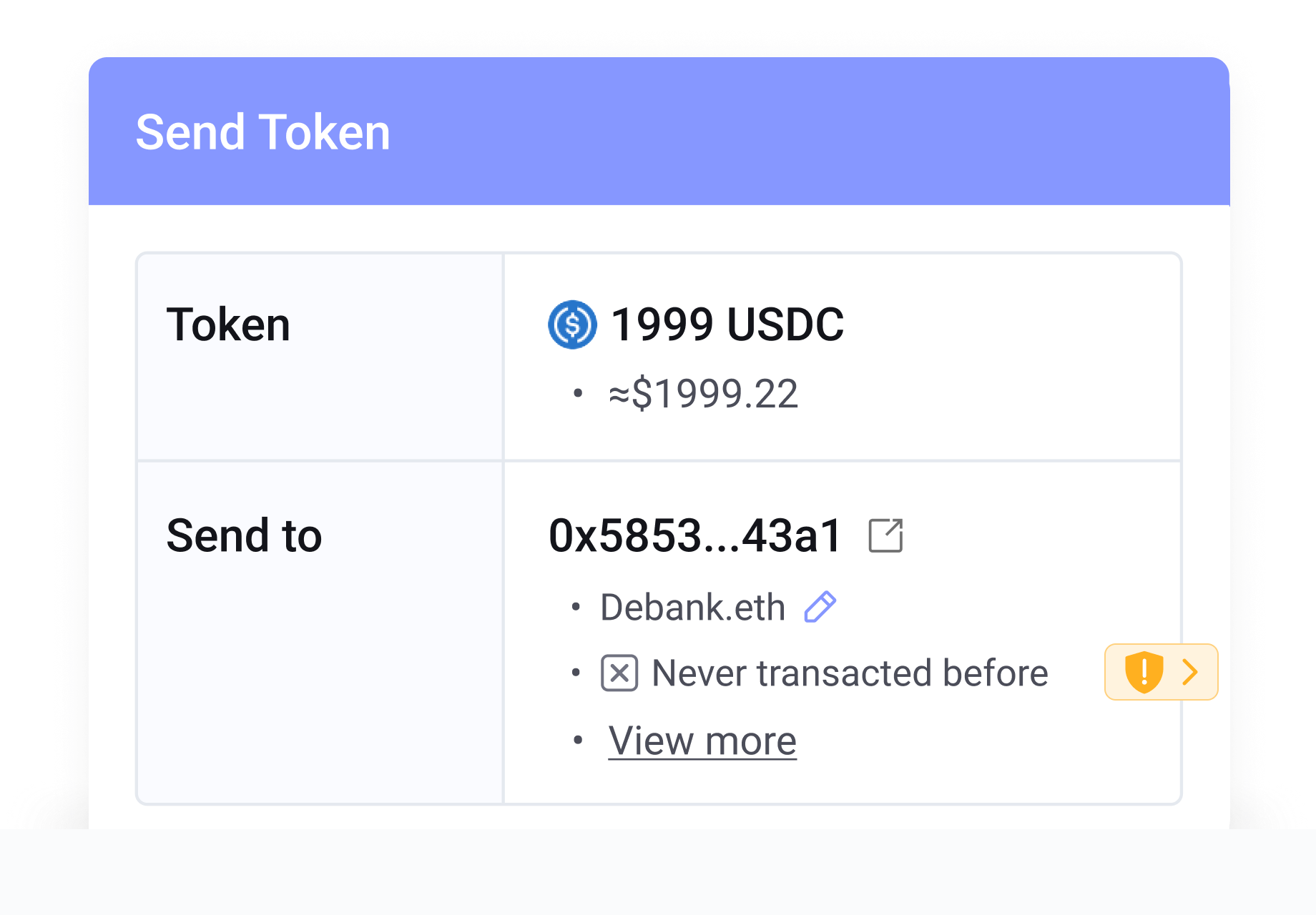
At its simplest, transaction simulation runs the requested transaction locally (or via a read-only node) against the chain state to compute the outcome without broadcasting it. For EVM chains this generally means executing the same calldata and value against the current block state in a node or simulated environment, producing concrete outputs: token transfers triggered, balance deltas per address, gas used, and whether the call would revert. Rabby leverages this mechanism to show exact estimated token balance changes and fee costs before you sign, turning an opaque byte string into a human-readable delta.
That conversion is the critical mechanism. Blind signing—the practice of approving transactions without understanding their effects—is common because raw calldata is inscrutable. Simulation translates calldata into a decision-useful narrative: “If you sign this, you will transfer X tokens, approve contract Y to spend Z, and pay N gas.” That translation is what converts signing from a ritual into a guardrail.
Where simulation reduces risk — concrete attack classes it mitigates
Transaction simulation is particularly effective against a few high-probability mistakes and attack patterns:
– Errant approvals: Simulated outputs reveal whether a transaction is an approval that sets unlimited allowance for a token, allowing you to spot overly broad allowances before they are on-chain.
– Token-redirects inside swaps: Some malicious or buggy swap contracts can route tokens to different recipient addresses; simulation shows exact post-trade token balances and recipient deltas so you can detect unexpected routing.
– Fee surprises and gas estimation errors: Cross-chain and layer-2 transactions sometimes misreport gas; simulation reveals realistic fee expectations, which is important for users managing tight arbitrage margins.
– Non-existent recipients and obvious reverts: Simulations will signal if the call would fail (revert) given the current state, saving you from paying a failed-gas bill in many cases.
What simulation cannot guarantee — boundary conditions and limitations
Simulation is powerful but not omnipotent. Be explicit about its limits before re-categorizing it as a complete security solution.
– State drift and frontrunning: Simulation evaluates the transaction against the state at simulation time. In congested markets or during mempool manipulation, the actual state when your transaction executes can differ—so a simulation that shows a safe outcome might not reflect front-running, sandwich attacks, or MEV extraction after you sign.
– Malicious contracts that change behavior: If a contract’s behavior depends on off-chain data, oracle state, or time-bound conditions that can change between simulation and execution, the simulation can’t foresee real-world changes. Similarly, if a deployed contract upgrades or uses delegatecall into unpredictable code between simulation and execution, the pre-checks can be incomplete.
– Trust in the simulation path: The safety of simulation depends on the node or environment used for simulation. If the wallet’s simulation uses a compromised or incorrect RPC endpoint, its outputs may be deceptive. Rabby mitigates this by being open-source and integrating with robust RPC providers, but the user must still be mindful of RPC trust assumptions—especially when using custom nodes.
Trade-offs compared with other controls — what to combine and when
Security is layered. Transaction simulation reduces cognitive load and catches many classes of errors, but it’s most effective when combined with other controls. Here’s a compact decision framework for a U.S.-based DeFi power user deciding between Rabby (with simulation) and alternate protections:
– High-value, low-frequency transfers (e.g., moving treasury funds): Favor multisig (Gnosis Safe) plus hardware wallets. Simulation helps verify proposals before signing, but the highest assurance comes from threshold signatures and independent signers. Rabby integrates with Gnosis Safe, making it a convenient front-end to combine simulation with multisig checks.
– High-frequency trading or arbitrage: Simulation is very useful because it speeds up verification of the intended effect and fees. However, add MEV-aware execution paths (private RPCs or Flashbots) and hardware wallet signing for large single-signature exposures.
– Routine DeFi activity and approvals: Use simulation together with approval revocation workflows. Rabby’s built-in revocation tool is a significant operational advantage because it shortens the detection-to-remediation loop when you spot suspicious approvals via simulation.
Comparative landscape: Rabby vs. MetaMask, Trust Wallet, Coinbase Wallet
Many wallets offer basic transaction previews and gas estimates, but the depth and workflow differ. MetaMask remains the default for many users due to ubiquity; Trust Wallet and Coinbase Wallet emphasize mobile accessibility and fiat on-ramps. Rabby distinguishes itself with a combined set of behaviors designed for active DeFi users: explicit pre-transaction simulation, automatic network switching to match the dApp (reducing accidental cross-chain errors), an approval revocation UI, and institutional integrations.
These differences imply trade-offs:
– Usability vs. security posture: MetaMask’s simplicity and widespread integration make it convenient, but it requires more manual vigilance to avoid blind approvals. Rabby raises the bar by converting unclear calldata into simulated state changes; the trade-off is slightly more UI complexity for users who want the extra detail.
– Institutional needs: If your organization already uses Fireblocks or Amber, Rabby’s integrations make it easier to slot into existing custody stacks. By contrast, wallets that lack such integrations require bridging or bespoke tooling for institutional workflows.
Operational prescriptions — a practical checklist for using simulation safely
Here are concrete, reusable heuristics for DeFi power users operating in the U.S. environment:
1) Always read the simulated delta for approvals. If a transaction sets an allowance to maximum or grants transferFrom rights to an unfamiliar contract, pause and use revocation tools after testing smaller allowances.
2) Combine simulation with hardware signing for high-value transactions. Simulation tells you “what”; the hardware device ensures the signing key is offline and harder to exfiltrate.
3) Use private RPCs or MEV-aware relays for large, time-sensitive transactions. Simulation helps prepare the transaction, but protecting execution requires infrastructure choices that reduce mempool exposure.
4) For treasury or institutional flows, run the simulation output through an independent auditor or automated policy check as part of the multisig proposal. Rabby’s compatibility with Gnosis Safe and enterprise providers makes this practical.
5) Maintain a habit of periodic approval audits—use built-in revocation tools when simulation reveals risky allowances. Revocation limits the window an attacker has even if an approval was previously granted.
Decision-useful takeaway and what to watch next
Transaction simulation is not a magic bullet but it is a material reduction in operational risk for active DeFi users. It converts opaque calldata into a usable audit trail at the moment of signing—an intervention that closes many common mistakes. The single most actionable heuristic: if you do only one thing today, stop blindly signing approvals and inspect the simulated token deltas and allowance changes before you confirm.
Signals to monitor in the near term: improvements in RPC trust models (authenticated or attested RPC responses), wider adoption of execution paths that narrow mempool exposure, and expanded institutional APIs that let simulation outputs feed automated policy gates. Each of these would increase the reliability of simulation as a control; conversely, a rise in MEV sophistication or off-chain oracle manipulation would blunt some of its benefits unless paired with improved execution guarantees.
If you want to try a wallet focused on these defensive features and multi-chain DeFi workflows, explore the project documentation and downloads here: https://sites.google.com/cryptowalletextensionus.com/rabby-wallet/
FAQ
Q: Does transaction simulation replace a hardware wallet or multisig?
A: No. Simulation reduces information asymmetry before signing but does not change custody assumptions. Hardware wallets protect private keys from exfiltration; multisig moves custody thresholds into policy. Use simulation to verify intent, then use hardware or multisig for high-value operations.
Q: Can simulation detect malicious contracts that later change behavior?
A: Not reliably. Simulation evaluates current on-chain logic. If a contract is designed to be upgradable, depends on off-chain signals, or can be exploited by later state changes, a single simulation snapshot may be insufficient. This is why inspection of contract code, provenance, and upgradeability patterns remains necessary.
Q: Is simulation vulnerable to RPC manipulation?
A: Yes—if the RPC endpoint used for simulation returns falsified state, the simulation output will be misleading. Trust in the RPC layer is a real dependency. Use reputable providers, run your own node for sensitive flows, or prefer clients that support multiple independent RPCs.
Q: How does Rabby’s approval revocation fit into this picture?
A: Approval revocation shortens remediation time: once a risky approval is discovered (via simulation or audit), you can revoke it without interacting with the contract that received the allowance. That reduces the effective attack window and is a practical complement to pre-sign simulation.